

Automation has long been part of marketing’s DNA. From scheduling social media posts and running drip email campaigns to cleaning and segmenting data, marketers have been leveraging the benefits of marketing automation to scale efforts and reach the right audience with minimal manual effort.
But AI‑powered marketing automation benefits are a different shift altogether.
Understanding how to automate marketing with AI goes far beyond doing the same things faster. It’s about changing how data-driven marketing decisions are made: how content is created using AI content generation, how audiences are identified through machine learning in marketing, and how campaign performance optimisation happens in real time rather than in the next quarterly review.
AI is pushing marketing teams into a far more competitive landscape, where speed, relevance, and precision are no longer nice‑to‑haves but expectations, and this is raising legitimate questions for executives evaluating their martech stack.
- Is the ROI real?
- Are the tools mature enough?
- Will AI disrupt existing workflows more than it improves them?
If these are the questions you’re grappling with, you’re exactly who should read further.
Below are 15 concrete, boardroom‑relevant reasons why integrating AI in marketing strategy automation isn’t just a smart move anymore for executives. It’s an urgent one.
How AI Marketing Automation Improves ROI
1. Reduce Customer Acquisition Cost with AI
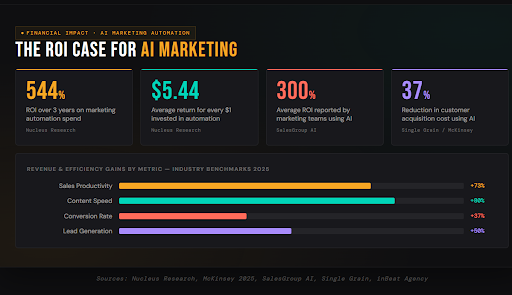
Traditional acquisition spending has too many overhangs. Misaligned targeting, manual budget allocation, and campaigns that run long after they stop performing. AI eliminates that waste through data-driven marketing decisions and precision customer segmentation, which humans simply can’t replicate at scale. According to Single Grain, brands using AI-powered marketing optimisation report an average 37% reduction in customer acquisition costs compared to traditional methods. Similarly, McKinsey notes that companies using AI for marketing automation reduce CAC by as much as 25%.
That’s a budget you can redeploy, not just save.
2. Marketing Automation ROI Statistics Speak for Themselves
The financial case for marketing automation ROI is not speculative. The 2025 data is definitive. Nucleus Research reports that businesses see an average $5.44 return for every $1 invested in marketing automation, translating to a 544% ROI over three years. Marketing teams implementing AI solutions report an average ROI of 300%, per SalesGroup AI. For companies under pressure to justify every budget line, these marketing automation ROI statistics are the numbers worth putting in front of your board.
Operational Wins from AI Marketing Automation
3. Round-the-Clock Campaign Performance Optimisation
Your marketing team clocks out. AI doesn’t. Automated systems continuously monitor campaign performance optimisation – adjusting bids, pausing underperforming ads, and sending personalised follow-up messages at 2 AM, right when a prospect is considering their options. Microsoft’s own data shows that AI-powered tools boost click-through rates by 1.5x and accelerate customer journey optimisation by over 30%. These gains compound when systems operate without downtime.
4. Marketing Personalisation at Scale
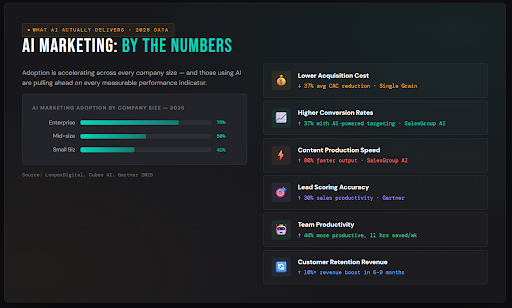
Personalisation used to mean putting a customer’s first name in an email. Today, AI analyses behavioural data, purchase history, and engagement signals to deliver marketing personalisation at scale. That means the right message, on the right channel, at the right moment, for thousands of customers simultaneously. SalesGroup AI reports that companies using AI-powered marketing strategies see 37% higher conversion rates. Meanwhile, 71% of consumer-facing brands say AI has been crucial in enabling real-time personalisation in 2025.
5. AI-Powered Lead Scoring Benefits Your Entire Revenue Funnel
Not all leads are equal, and your sales team’s time is finite. AI powered lead scoring analyses hundreds of data points:
- website behaviour
- email engagement
- firmographic data
- social signals
to rank leads by conversion likelihood, enabling truly intelligent automated lead nurturing.
According to Gartner research, companies using AI-powered lead scoring models experience a 30% increase in sales productivity and a 25% decrease in sales cycle length. Your team stops chasing cold leads and starts closing warm ones.
6. AI Marketing Tools for Business Accelerate Time-to-Market
New product launch? Campaign pivot? AI marketing tools for business can generate copy variations, build audience segments, and schedule multi-channel content in a fraction of the time a traditional team would need. Using AI content generation, what once required a week of production now takes hours. Research from SalesGroup AI highlights that AI reduces content production timelines by up to 80%. Speed-to-market is a real competitive advantage, and AI hands it to you.
7. Predictive Analytics in Marketing That Actually Predict
AI doesn’t just report on what happened, it forecasts what’s likely to happen. Predictive analytics in marketing is now mainstream: according to SQ Magazine, 88% of marketers in 2025 use predictive analytics to inform campaign decisions, and AI forecasting accuracy has improved by 33% over traditional tools. Predictive models built on machine learning in marketing can tell you which customers are about to churn, which segments are ready to upgrade, and which campaigns are likely to underperform before you’ve committed the budget.
Strategic Business Growth Advantages from AI Marketing Strategy
8. AI Tools to Improve Marketing Productivity Structurally
AI automation frees your marketing team from repetitive, time-consuming tasks such as campaign monitoring, customer segmentation AI, performance reporting. So, they can focus on strategy and creativity. These marketing productivity gains are substantial:
LoopexDigital’s analysis shows that marketing teams are 44% more productive thanks to AI, with professionals saving an average of 11 hours per week.
That’s not a marginal gain. It’s a structural improvement in how your team operates and a direct argument for deploying AI tools to improve marketing productivity across every function.
9. Consistent Brand Voice Across Every Channel
One of the quiet challenges of scaling marketing is maintaining consistency. With different writers writing for different markets and platforms, the brand voice gets diluted. AI content generation tools trained on your brand guidelines produce consistent output across email, social, ads, and web copy at scale. According to HubSpot, 77% of marketers now use AI-powered automation to create personalised, on-brand content in 2025 without extensive editorial overhead slowing down every campaign.
10. Scalable Content Without Proportional Headcount Growth
Growing your marketing output traditionally meant growing your team. Generative AI in marketing breaks that linear relationship. With AI-assisted content generation, one marketer can now produce what would have previously required five. Research from SalesGroup AI confirms this: 93% of marketers use AI to create content faster, with production timelines reduced by up to 80%. You scale content, campaigns, and channels without scaling your payroll, making it one of the strongest benefits of marketing automation for growing enterprises.
11. Deeper, More Actionable Customer Insights
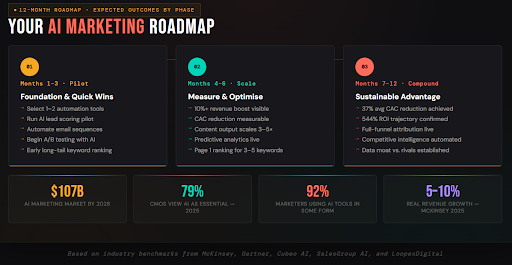
AI processes data at a volume and velocity no human team can match. It surfaces patterns, correlations, and audience insights that inform truly data-driven marketing decisions. These are insights that would otherwise be buried in a spreadsheet forever. McKinsey’s 2025 Global AI Survey found that businesses using generative AI in marketing and sales saw real revenue growth of 5% to 10%, with two-thirds reporting higher revenues driven in large part by sharper intelligence that wasn’t accessible before.
12. Better Marketing Automation ROI Through Smarter Attribution
Multi-touch attribution has always been a headache. Which channel deserves credit for the conversion? AI-powered attribution modelling analyses the entire customer journey and assigns accurate credit across every touchpoint. Revenue Memo’s analysis notes that 55% of companies using AI-driven automation report higher conversion rates, specifically due to improved personalisation and attribution, meaning better marketing automation ROI through smarter spend, not more spend.
13. Competitive Intelligence That Never Sleeps
Building an effective AI marketing strategy for business growth requires knowing what your competitors are doing in real time. AI tools can continuously monitor competitor activity, ad strategies, content cadence, keyword movements, and pricing shifts, surfacing alerts when something meaningful changes. Gartner predicts that traditional search engine volume will drop by 25% by 2026 as AI-powered discovery takes over. Organisations that automate their intelligence gathering will be the first to respond.
14. Proactive Customer Retention That Pays for Itself
Acquiring a new customer costs 5 to 25 times more than retaining an existing one. AI enables proactive retention by identifying early churn signals and triggering personalised re-engagement sequences — part of a broader customer journey optimisation that runs automatically. Companies implementing AI-powered marketing automation see a 10%+ boost in revenue within 6–9 months due to improved lead management and retention. Loyalty programmes, renewal nudges, win-back campaigns — all powered by automated lead nurturing, all running around the clock.
15. AI Marketing Automation for Enterprises Compounds Over Time
Here’s what separates AI marketing automation for enterprises from a standard tech investment: it gets better with use. The more data your AI systems process, the more accurate the predictions, the better the personalisation, and the sharper the insights. This is the compounding advantage of deploying the right martech stack early. The global AI marketing industry has already grown from $12.05 billion in 2020 to $47.32 billion in 2025 – a 293% increase in just five years, with projections pointing to $107.5 billion by 2028. Organisations that start now build a data and intelligence moat that latecomers will struggle to bridge.
The Bottom Line for Leadership
Embedding AI in marketing strategy isn’t a technology decision – it’s a business growth decision. It affects revenue, cost structure, team capacity, customer experience, and competitive positioning all at once. The organisations leading their categories right now aren’t the ones with the biggest budgets – they’re the ones who chose to automate their marketing strategy with AI before the window of easy advantage closed.
As 79% of CMOs now agree, AI is no longer optional – it’s an essential pillar of any serious AI marketing strategy for business growth. The question isn’t whether it belongs in your martech stack. It does. The question is how much ground you’re willing to cede while you wait to find out.
| Ready to explore how AI can transform your marketing operations? Start by auditing one channel or campaign type where automation could have an immediate impact. The results will speak for themselves – SCRIBBLE COPIES |